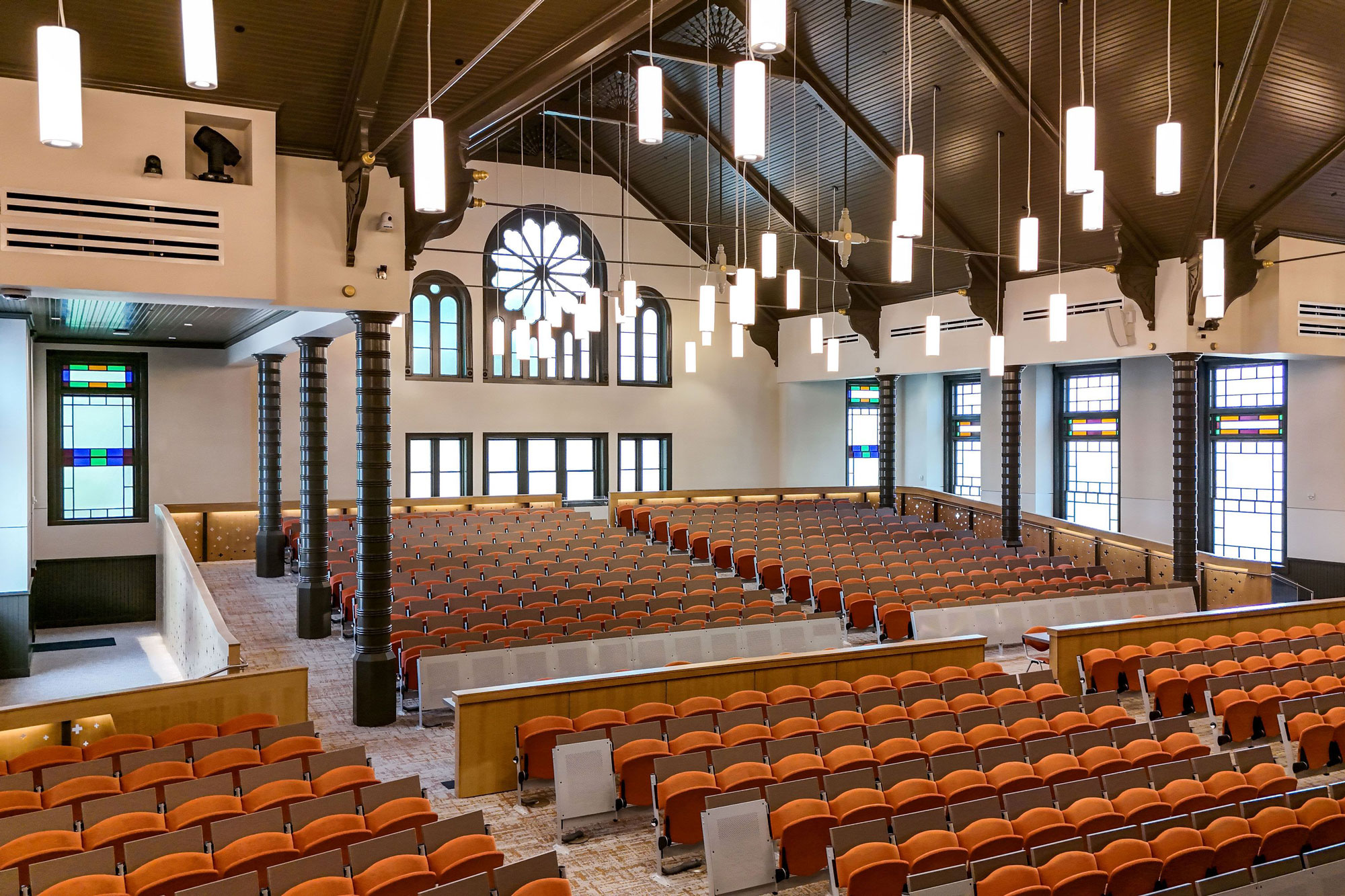
In the heart of Clemson University’s campus sits Tillman Hall Auditorium. Built in 1891, this historic building hosts numerous campus events and serves as a gathering space for students.
Harper was chosen to transform the auditorium into a modern learning space while preserving its historic character. Upgrades such as lighting, audio-visual systems, seating, and accessibility were integrated into the historic framework. The 14,000 square-foot project blended modern amenities with preserved elements of the original chapel design. Four original columns were exposed and replaced for structural reasons, and in doing so, they were enhanced with recreated beaded column wraps based on historic photographs. Original wood wainscoting, balcony panels, and decorative trim were meticulously repaired, replicated, and reinstalled to honor the building’s architectural heritage.
To ensure precision, Harper deployed 3D scanning and total station technology for all new elements. For the accurate reconstruction of the auditorium’s curved railings around the seating platforms, Harper scanned the radius walls and utilized CAD and CNC machining to fabricate the wall sections with precise detail. Additionally, Harper scanned the basement ceiling to identify a more efficient route for the plumbing stack, which minimized disruption and avoided conflicts with existing systems. Energy-saving design elements included collaborating with acoustic professionals to integrate sound walls, acoustic ceilings, duct silencers, and multiple layers of drywall to ensure clear audio, which reduces excessive amplification during events and lowers energy consumption. Additionally, the team restored natural light by uncovering original window features that had long been closed off.
One of the project’s biggest challenges was the undertaking of significant abatement, concrete, and steel deconstruction to replace the seating risers for the new design. The concrete removal required seismic monitoring to protect original brick walls. Four original cast iron columns were replaced with structural steel, and because historical load calculations were unavailable, new load requirements were established to ensure proper shoring for the column replacement. During demolition, extensive deterioration of the original 1893 plaster was discovered behind framed walls. Recognizing its historical significance, Harper, along with a plaster specialist, concluded that a consolidation process was necessary to stabilize and preserve the plaster while maintaining its historical integrity.
In regard to safety, the team planned activity around class schedules and events, often scheduling loud or disruptive work at night or during classroom breaks. Because the fire sprinkler system was offline, a 24/7 fire watch was maintained to ensure constant protection. Harper General Contractors logged over 69,000 worker hours with a zero lost time accident rate and no recordable cases – all while completing this project below budget and ahead of schedule. Congratulations to Harper General Contractors, Lord Aeck Sargent and Clemson University!