Carolinas AGC bestowed the 2025 Pinnacle Awards to five construction projects which enhance their communities, and a “Build with the Best” Pinnacle Award to an individual whose partnership efforts strengthen the construction industry. Pinnacle entries are judged on unique aspects and challenges; special values; project management; budget and schedule; and safety performance. Pinnacle winning projects enhance the Carolinas and advance the construction industry! 

The CAGC Pinnacle Awards competition is co-sponsored by CPA firm GreerWalker LLP and the law firm of Johnston, Allison & Hord, both based in Charlotte. The Pinnacle Award ceremony was held at CAGC's 105th Annual Convention in Aruba in January. 

Johnston Allison Hord Attorneys    Greer Walker CPA

Build with the Best Pinnacle Award

Lamar Sylvester, Retired NCDOT Chief Engineer

NCDOT Logo

Lamar SylvesterLamar Sylvester began his career with the North Carolina Department of Transportation in 1995, serving in various roles across the Highways and Aviation Divisions. As Chief Engineer, he oversaw all highway program areas, including Technical Services, Transportation Mobility and Safety, Construction, Materials and Tests, Alternative Delivery, Operations, Right of Way, Structures Management, and the 14 Highway Divisions.

Much of his involvement in the construction of infrastructure projects across the state required numerous interactions with Carolinas AGC members, whether there were issues on projects or changes to policies or procedures.  Lamar always tackled these issues head on, with a smile on his face, with the knowledge that a healthy construction industry is beneficial to everyone. 

Our members knew that he always searched for the right answers and never hesitated to reach out and discuss issues and solicit our input. His intelligence, attention to detail-- and most importantly his willingness to listen-- provided assurance that the contractors’ concerns were heard.  Whether you agreed with him or not, you knew that he thoroughly understood the issue.  

Thank you, Lamar, for all you’ve done to support our industry and our members!


Best Building Projects

Clemson University Tillman Hall Auditorium Renovation: Clemson, SC - Harper General Contractors

Harper General Contractors
Pinnacle Partner: Lord Aeck Sargent and Clemson University

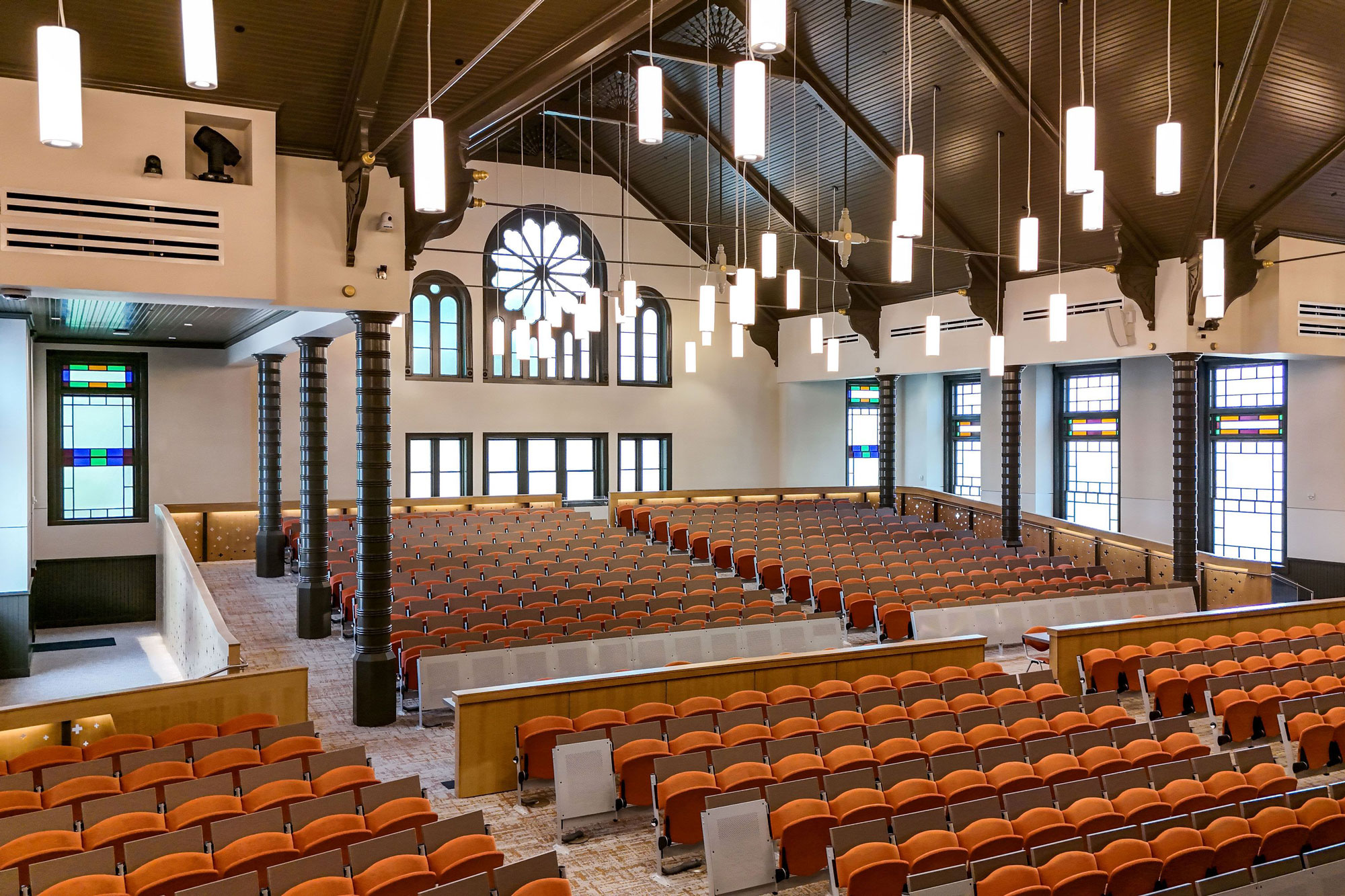
Tillman Hall Auditorium

In the heart of Clemson University’s campus sits Tillman Hall Auditorium. Built in 1891, this historic building hosts numerous campus events and serves as a gathering space for students.

Harper was chosen to transform the auditorium into a modern learning space while preserving its historic character. Upgrades such as lighting, audio-visual systems, seating, and accessibility were integrated into the historic framework. The 14,000 square-foot project blended modern amenities with preserved elements of the original chapel design. Four original columns were exposed and replaced for structural reasons, and in doing so, they were enhanced with recreated beaded column wraps based on historic photographs. Original wood wainscoting, balcony panels, and decorative trim were meticulously repaired, replicated, and reinstalled to honor the building’s architectural heritage. 

To ensure precision, Harper deployed 3D scanning and total station technology for all new elements. For the accurate reconstruction of the auditorium’s curved railings around the seating platforms, Harper scanned the radius walls and utilized CAD and CNC machining to fabricate the wall sections with precise detail. Additionally, Harper scanned the basement ceiling to identify a more efficient route for the plumbing stack, which minimized disruption and avoided conflicts with existing systems. Energy-saving design elements included collaborating with acoustic professionals to integrate sound walls, acoustic ceilings, duct silencers, and multiple layers of drywall to ensure clear audio, which reduces excessive amplification during events and lowers energy consumption. Additionally, the team restored natural light by uncovering original window features that had long been closed off.

One of the project’s biggest challenges was the undertaking of significant abatement, concrete, and steel deconstruction to replace the seating risers for the new design. The concrete removal required seismic monitoring to protect original brick walls. Four original cast iron columns were replaced with structural steel, and because historical load calculations were unavailable, new load requirements were established to ensure proper shoring for the column replacement. During demolition, extensive deterioration of the original 1893 plaster was discovered behind framed walls. Recognizing its historical significance, Harper, along with a plaster specialist, concluded that a consolidation process was necessary to stabilize and preserve the plaster while maintaining its historical integrity.

In regard to safety, the team planned activity around class schedules and events, often scheduling loud or disruptive work at night or during classroom breaks. Because the fire sprinkler system was offline, a 24/7 fire watch was maintained to ensure constant protection. Harper General Contractors logged over 69,000 worker hours with a zero lost time accident rate and no recordable cases – all while completing this project below budget and ahead of schedule. Congratulations to Harper General Contractors, Lord Aeck Sargent and Clemson University!


Coastal Credit Union Headquarters Renovation: Raleigh, NC - Barnhill Contracting Company

Barnhill Contracting Company

Pinnacle Partners: Precision Walls and Triple-R Electric

Coastal Credit Union

After years of working from home during and post-COVID, Coastal Credit Union wanted to ensure its employees felt comfortable coming back to the office by renovating corporate headquarters to offer greater connectivity with indoor-outdoor flowing spaces. The project features open office spaces, collaboration areas, meeting rooms, and uniquely-designed ‘communicating stairways’ – stairs which are open and don’t require users to exit into a hallway or common corridor. The work was executed in phases, beginning at the top and progressing downward through all six floors, covering more than 150,000 square feet, all while the building remained in use. Challenges included protecting lower floors, which store massive amounts of documents, from both construction and frequent rainstorms. Existing slab was evaluated to ensure it was watertight, and exterior precast panels were sealed to the slab, column penetrations, cracks in the slab, shafts and existing slab penetrations. After rounds of testing and collaboration, the team created a waterproof solution that wouldn’t compromise future design plans. Not only could this product withstand water, but it would also be compatible later with the scheduled floor finishes. The team also implemented multiple approaches to minimize the intrusion and exposure from plastic, building wrap, and more by building a combination of both permanent and temporary walls to facilitate reliable protection. 

One standout design feature-- and one of the most critical hurdles during phase two of the project-- was the construction of the outdoor terrace, which ties into a new two-story interior social hub and includes a pedestrian bridge. Barnhill had to carefully examine and approach the excavation of the new foundations and implement safety measures to refrain from undermining the existing retaining walls. The construction of this feature could not begin until the later part of phase two in order to accommodate reconstruction sequencing of the interior and façade tied to the new terrace. 

The interior provided its own critical hurdle that revolved around the process and components to create the two-story social hub area. The team had zero room for error as they managed the required process including temporary shoring and bracing, demolition of the existing floor system, installation of new foundations and structural steel members, infilling depressed slab on grade, and construction of curtainwall. This scope had to be carefully scheduled and completed prior to proceeding with the installation and construction of the terrace structure and featured elements. 

The Coastal Credit Union project stands as a benchmark for exceptional safety performance, with zero lost time incidents recorded across nearly 400,000 man-hours. Congratulations to Barnhill Contracting Company and their Pinnacle partners Precision Walls and Triple-R Electric.


Best Highway Projects

SCDOT Gaffney T Bridge: Gaffney, SC - Reeves Construction Company

Reeves Construction Company

Pinnacle Partners: Augusta Iron & Steel Works, Concrete Supply Co., and Bullington Construction

SCDOT Gaffney T Bridge

Originally constructed in 1919 using cast-in-place concrete T-beams, this bridge was widened in 1970 using structural steel for the deck girders. The eastern approach retaining wall and bridge deck act as the vertical spine of the T which spans over Norfolk Southern tracks. This uniquely designed structure—one of only two in the world—provides a critical route for emergency vehicles to safely cross over the tracks. The rehabilitation of the historic T-Bridge originally included repainting the bridge and retaining walls and upgrading the sidewalks, concrete barrier, metal railings, and lighting. During construction, bridge inspections uncovered severe structural deficiencies that reduced the load rating capacity, eliminating the ability of emergency vehicles to utilize the bridge. Due to the timing of when the structural issues were discovered, Reeves had to carefully coordinate, analyze, research, and problem-solve in order to not affect or redo work that was already completed.

The additional repairs and the city’s desire to extend the limits of the contract nearly tripled the original scope of work to a project where construction access, design, and timing were already a challenge. A substantial portion of the bridge had to be accessed by going over the busy NSRR railroad. Reeves, SCDOT, and NSRR coordinated daily on available track time. And while painting usually doesn’t come with many challenges, limited clearance between the top of the train cars to the bottom of the girders resulted in the creation of a removable tarp system that could be quickly installed or removed while painting. 

Achieving the required bridge load rating was difficult due to the state of the existing 104-year-old structure. The additional weight of the new barrier and sidewalk combined with the deck elevation difference of the two previous projects proved to be a challenge. Other challenges discovered throughout the project were finding the original wood decking still cast into the bottom of the deck, layers of sand in between the original concrete deck and asphalt overlay, and cracks in the existing retaining wall on the southwest side of the project. In regard to the community’s safety, enhancements included additional lighting, handicap accessible sidewalks, and increased capacity of the structure which allows continued use by emergency vehicles. Most importantly though, with this bridge being the only access over the railroad tracks when trains pass through town, emergency vehicles no longer have to wait on train traffic during emergencies.

Reeves had zero recordable, first aid, or lost time incidents on this two-year project. Congratulations to Reeves Construction Company, Augusta Iron & Steel Works, Concrete Supply Co., and Bullington Construction.


Military Cutoff Extension: Wilmington, NC - Balfour Beatty

Balfour Beatty

Pinnacle Partners: Coastal Precast Systems, S&W Ready Mix Concrete, and Barnhill Contracting

Military Cutoff Extension

This critical $95 million dollar project-- which is the gateway to the future Hampstead Bypass-- serves as a main artery to help ease evacuation routes. It included 4 miles of green alignment through dedicated right of way, and was flanked by existing housing developments on both sides of the proposed alignment. Four box culverts and bridges were constructed, and it also included storm drainage, water and sewer utilities, guardrail, and signage. Before this alignment was constructed, evacuation to I-40 was only possible via US-17 (also known as Market Street), which is one of Wilmington’s heaviest traveled sections. This stretch of road, averaging 23,000 vehicles a day, is projected to increase to 45,000 within 20 years. 

The most unique aspect to this project was the borrow requirements needed with such limited access to get the material to the alignment. With only 3 access points to get 2 million Cubic Yards of borrow to the project, and only a single road that bisected the project, this road was surrounded by housing developments and pedestrian traffic. Balfour Beatty felt the safest and quickest way to get the material to the project was to build a conveyor over I-140, eliminating 200,000 standard dump truck loads from interrupting traffic flow. Wet utilities were a major factor on the project’s critical path. The 1.5 miles of urban widening along Market Street required relocating waterline and gravity and forced sewer. Five months into construction, unexpected issues halted utility work. The water and sewer plans were redesigned and upsized for future development, delaying progress by 10 months. When work resumed, further redesign was required—this time for constructability and long-term maintenance concerns. There were many other challenges leading to changes on the project due to “after the fact” considerations by the Utility Owner, the NCDOT, and requests from the general public. These requests led to additional multi-use paths, additional large diameter piping to control runoff from neighborhood development, and the construction of sound walls. 

Tragically on April 11, 2024, an employee of Pinnacle Partner Barnhill Contracting was spotting asphalt paving operations when she was hit and killed by an intoxicated driver. Although traffic control was in order and neither Barnhill or Balfour Beatty were found at fault, the incident motivated the entire team to continue adhering to the strictest safety standards. This commitment to safety resulted in the project being designated as a “Building Star Site” by the North Carolina Department of Labor. Over 5 years and nearly 600,000 manhours worked, the project was delivered with zero lost time incidents. Congratulations to Balfour Beatty and Pinnacle Partners Coastal Precast Systems, S&W Ready Mix Concrete, and Barnhill Contracting.


Best Utility Projects

Clarke Creek PS, Force Main, Gravity Sewer & McDowell Creek Wastewater Treatment Plant: Huntersville, NC - State Utility Contractors

State Utility Contractors

Pinnacle Partner: Morrison Engineers and Smart Electric Company


Clarke Creek PS, Force Main, Gravity Sewer & McDowell Creek Wastewater Treatment PlantPortions of Charlotte Water’s wastewater service area in eastern Mecklenburg County drain easterly towards Cabarrus County. Historically, these flows would travel by gravity, then treated by the Water and Sewer Authority of Cabarrus County, then discharged into the Rocky River basin. Charlotte Water sought to offset these flows due to transfer constraints, increased sewer demands and costs of treatment by Cabarrus County, as well as the anticipated future growth in eastern Mecklenburg County. The remedy: a new regional pump station, sanitary sewer line and force main along a five-mile corridor near Huntersville to redirect flow to an existing sewer collection system, and then on to the McDowell Creek Wastewater Treatment Plant. Due to system and time constraints, this required a phased infrastructure improvements plan to achieve flow diversion in the near-term and accommodate their long-term projections for increased community growth. 

A major challenge was securing a suitable project site. Four locations were evaluated, and initial design began on a Cabarrus County property. After four months of negotiations, the deal collapsed, forcing a restart of the site selection process. The team then procured a new site in Mecklenburg County near Huntersville within two months and quickly updated the design, permitting, and easement documents to keep the project on track. To construct the project within Charlotte Water’s timeline, the pump station and electrical building, force main and gravity sewer, and improvements at the McDowell Creek wastewater treatment plant needed to be constructed at the same time. To accomplish this, the project team allocated five full-time construction crews with additional support crews as needed. A significant challenge was the construction of a 50-foot wet well and the associated gravity sewer. Because ground water posed a significant challenge, the team utilized a dewatering system of 59 eductor wells drilled 60 foot deep. Other challenges included multiple road crossings, a railroad crossing, and major oil and gas pipeline crossings. 

During construction, Charlotte Water faced fiscal challenges that delayed or paused several capital projects. To help save the city money and keep this project on track, State Utility adjusted the design, reduced the scope, and phased work. The project was completed 23 days ahead of schedule, and the team was able to return nearly $11,300 of unused contingencies, allowances and unused funds back to the city. With over 200,000 manhours clocked, there were no loss time accidents and no reportable injuries. Congratulations to State Utility Contractors and partners Morrison Engineers and Smart Electric Company.


CAGC Construction Excellence Awards are recognized by the CAGC Pinnacle Award Judges as projects of distinction. 

Excellence Winners
For more information on previous Pinnacle Award winners, visit our Previous Pinnacle Award Winners page .

Previous Pinnacle Award Winners